History Resources

Welcome

So, you're writing a research paper for a history class. You've come to the right place! You might be a freshman taking Historian's Craft and wondering how you're supposed to read anything David Bebbington writes and find primary sources for the first time. You might be an upperclassman, maybe even writing your senior seminar paper, and you know that you've come to lean on many of these resources to complete the final piece of the puzzle. Either way, this research guide is for you. Your professors (and librarians!) want to help you, but that doesn't mean we want to do the work for you. After all: if you give a man a fish, he'll eat for a day; if you teach a man to fish, he'll eat for a lifetime. 

That doesn't mean that we can't provide the hooks and worms-- so consider this your tackle box.

Practice Research Skills!

The Reference & Instruction team at Thrift Library have designed a series of Scavenger Hunts to help you practice your skills finding information and using your research skills. These Scavenger Hunts will provide you with five terms to search in Google in order to determine a mystery person! Then, you will have the opportunities to further research that person in order to practice more with the library's resources.

Choose any of the following links to participate!

World History

  • AfricArXiv
    • AfricArxiv is a community-led digital archive for African research items such as research manuscripts, reports, datasets, code, illustrations, presentations, and more. By enhancing the visibility of African research, we enable discoverability and collaboration opportunities for African scientists on the continent as well as globally.
  • Archives Africa
    • Archives Africa is a digital repository enabling online access for the first time to a wealth of previously unexplored records on the history of Madagascar.
  • Asia Art Archive
    • Asia Art Archive (AAA) is an independent non-profit organization co-founded by Claire Hsu and Johnson Chang in 2000 in response to the urgent need to document and make accessible the multiple recent histories of art in the region. AAA has multiple different locations across the world devoted to sharing this mission for educational purposes.
  • The Avalon Project
    • The Avalon Project is an online document collection with various resources from all over the world arranged in a timeline order by students of Yale Law,  designed to mount digital documents relevant to the fields of Law, History, Economics, Politics, Diplomacy and Government.
  • The British Museum
    • The British Museum was founded in 1753 and opened its doors in 1759. It was the first national museum to cover all fields of human knowledge, open to visitors from across the world.
  • Christian Classics Ethereal Library
    • The Christian Classics Ethereal Library (CCEL) is an online collection of Christianity-based primary sources.
  • Digital Archive of Latin American and Caribbean Ephemera
    • The Digital Archive of Latin American and Caribbean Ephemera is a steadily-growing repository containing a previously unavailable subset of Princeton University’s Latin American Ephemera Collection, as well as newly acquired materials being digitized and added on an ongoing basis.
  • English Government State Council for the People's Republic of China
    • Contains a collection of primary sources from Chinese history which are translated into English.
  • EuroDocs
    • EuroDocs is designed to provide open access to online sources for European history including selected transcriptions, facsimiles and translations.
  • Fordham Sourcebooks
    • Fordham University in New York City presents the Internet History Sourcebook Project (IHSP): a collection of public domain and copy-permitted historical texts presented cleanly (without advertising or excessive layout) for educational use.
  • Hanover Historical Texts Project
    • The Hanover Historical Texts Collection makes available digital versions of historical texts for use in history and humanities courses.
  • Internet Archive
    • Internet Archive is a non-profit library of millions of free texts, movies, software, music, websites, and more.
  • Japan Center for Asian Historical Records
    • A digital archive connecting Japan and Asia Japan Center for Asian Historical Records makes available to the public historical materials on modern and contemporary relations between Japan and its neighboring Asian countries.
  • John Carter Brown Library of the Early Americas
    • The John Carter Brown Library contains high resolution images from the Library's archive of early American images, map collection, and political cartoon collection are available through Luna. Scans of over 15,000 full books are available through Internet Archive.
  • JSTOR
    • Using your AU sign-in credentials, JSTOR provides an open access model where you can not simply find secondary sources for your research, but you also may explore millions of high-quality primary sources and images from around the world, including artworks, maps, photographs, and more.
  • Latin American Digital Initiatives
    • The Latin American Digital Initiatives (LADI) repository is a collaborative project that preserves and provides digital access to unique archival documents from a network of Latin American partners with an emphasis on collections documenting human rights issues.
  • The Metropolitan Museum of Art
    • The Metropolitan Museum of Art (Met) hosts America's largest collection of historical artifacts from across 5,000 years of history through 490,000+ works of art.
  • National Security Archive at George Washington University
    • The National Security Archive's continually growing collection of Electronic Briefing Books (EBBs) provide timely online access to critical declassified records on issues including U.S. national security, foreign policy, diplomatic and military history, intelligence policy, and much more. Updated frequently, the EBBs represent just a small sample of the documents in our published and unpublished collections.
  • South African History Archives
    • The South African History Archives (SAHA) are located in a former women’s prison in the heart of Johannesburg which since the end of Apartheid in 1994 has been re-purposed to house a museum about the prison and political imprisonment, as well as numerous progressive organizations.
  • Wilson Center Digital Archives
    • Gain critical insights into international history and policy through declassified documents from governments, organizations, and individuals worldwide, curated by the Wilson Center.

Sistine Chapel - Wikimedia Commons

Accessing a Physical Book

Thrift Library is home to over 70,000 books. They can be very helpful when researching and working on projects. But how do you access them? Here is simple guide showing the two main ways of finding a physical book. 

Step 1: Search for the book

Begin by looking in the Thrift Library catalog. You can then narrow your search from the results page. This video gives you a quick tutorial:

Simple Search
You can do a simple search by entering the book title and/or the author into the search box. If you want to find books on your topic, enter 1-3 keywords that describe your topic. Keyword examples: ancient Greek vases; Vincent van Gogh; sculpting in the 19th century; Chinese wall hangings. 

Advanced Search
For more precise searching use the Advanced Search. Click "Advanced Search" to the right of the search box. Fill out the boxes to limit to specified fields like Title or Author. 

Physical Items
From the search results page you can limit your results to physical books held by Thrift Library. Look to the left side of the page under "Refine my results" and select the following options:
Under Resource Type, select Books
Under Availability, select Held by library

Step 2: Locating the book

Once you have identified the book you wish to use, note the call number (example: LC3731.F45 2002) and navigate to the stacks (shelves) on the second floor of the library. There is signage there to direct you in finding the items according to its call number.

Library of Congress Classification System
A call number is like an address for a book. It tells you exactly where to go to find the book on the shelf. The call number is made up of letters, whole numbers, decimals, a publication date, and occasionally a volume and/or copy number. This allows for each book to have a specific location. One book's location cannot be confused with another book's location. 

Thrift Library uses the Library of Congress Classification System; here is an example: LA 212 .R423 2005
LA specifies the subject classification (L for Education and A for History, so History of Education).  
212 is read as a whole number. 
The next line, .R423, is called the Cutter number. This line is read as a decimal (.R423 would come after .R76). 
2005 is the publication date.  

Step 3: Checkout

Once you have acquired your book, you are free to peruse it at your leisure. If you have finished using it while you are here, return it to the desk. If you want to take it with you, you can check it out. All you have to do for that is to come to the front desk with your student ID, which serves as your library card. Someone should be there to assist you. They will then check out the book and let you know about the due date for return, and  you can check that by signing into the catalog at any time after checking out!

PASCAL and Interlibrary Loan

If Thrift does not have something you are looking for, you can request it from other libraries! 

PASCAL Delivers

PASCAL is a FREE, rapid delivery interlibrary loan (ILL) service for print books and digitized copies of journal articles and book chapters. 

1. Use the catalog as you normally would (i.e. the above instructions.)
2. If you cannot find the item(s), enable "Add results available through interlibrary loan" under the "Refine my results" menu on the left side of the page: 
3. Click on the title of the item you would like to request and click the appropriate button to open the PASCAL Delivers Request Form. Make sure that the bibliographic data you provide in the form is complete and accurate. 
4. Physical books will arrive at the PASCAL library location you selected within 2-14 days. You will receive an email when your items are ready for pickup. Digital items will be emailed directly to your AU email account, typically within 1-5 days.

ILL Request Options

All loaning systems in addition to PASCAL can be found here

For any questions about these services, you can contact reference@andersonuniversity.edu.

Reading LOC Call Numbers

  1. Visit the second floor of Thrift Library, where you'll find the stacks!
  2. Look at the first letter(s). Books are arranged in alphabetical order.
    • N comes before P
    • PL comes before PN
    • Browse the signs on the end of the bookshelves to find your section
  3. When you find the correct shelving area, scan over the numbers on the spine label (102 is one hundred two, not 1-0-2).
  4. After that number, search alphabetically from the other letter after the decimal.
  5. Some copies are arranged by publication date as well, the year will appear at the end of the call number. 

Example

NB 1115 .A32 2020

NB is the section to search for, in alphabetical order between NA and NC

1115 is the numbers before the decimal in numerical order on the shelf.

A32 after the decimal will be in alphabetical and then numerical order.

2020 is the publication year. If another edition of the same book was published in 2018, the two copies will be right next to each other with 2018 appearing first because they are shelved in chronological order.

Accessing E-Books and articles

Begin by looking in the Thrift Library catalog. You can then narrow your search from the results page.

 This video gives you a quick tutorial:

Simple Search
You can do a simple search by entering the book title and/or the author into the search box. If you want to find books on your topic, enter 1-3 keywords that describe your topic. 

Keyword examples: ancient Greek vases; Vincent van Gogh; sculpting in the 19th century; Chinese wall hangings.

Advanced Search
For more precise searching use the Advanced Search. 

Click "Advanced Search" to the right of the search box

Fill out the boxes to limit to specified fields like "Title" or "Author." 

Limit Search Results to E-Books
From the search results page you can limit your results to electronic (digital) books held by Thrift Library.

Look to the left side of the page under "Refine my results" and select the following options:

  • Under "Resource Type," select "Books"
  • Under "Availability," select "Available online"

Articles and Journals
From the search results page you can also look at physical items, articles, or essays written on the topic of your choice. 

Use "Refine my results" to hone in on these as well by selecting things like Peer-Reviewed Journals and Articles.

Accessing Periodicals and Journals through the Library Catalog

Search for Articles

The Thrift Library catalog provides access to peer-reviewed, scholarly journals and trade journals in digital format via its many databases. 

Locate an Article 

Use the search box in the Thrift Library catalog to search for articles across most of the library's subscription databases.

Not all databases are integrated with our catalog. Searching individual databases will help you cast a wider net. 

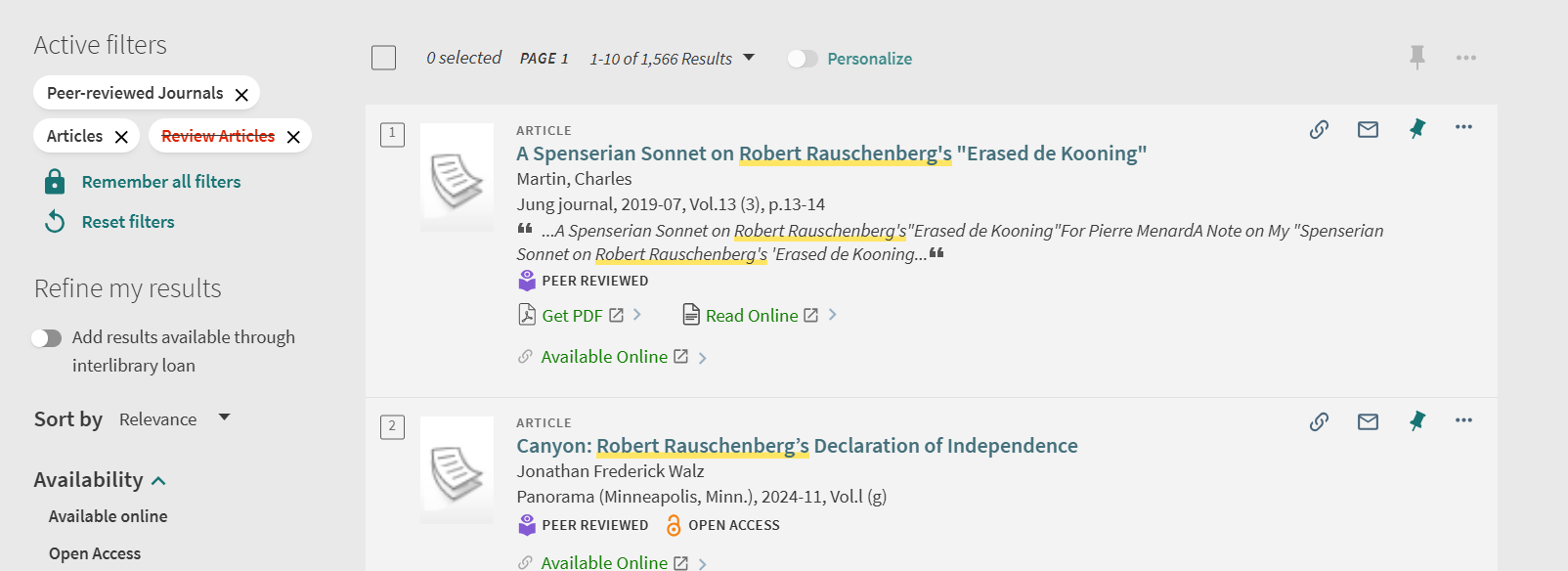
On the search results page, look under "Refine my results" on the left side.

Select "Peer-Reviewed Journals" and "Articles.

To exclude other options, select the red box beside a filter, such as the one for "Review Articles" so that your results are limited to the type of article you want.

An example screenshot with these filters on would be this: 
 

Once you locate an item, open its record and scroll to the "View Online" section to see which database(s) provide access to it.

 Note that databases provide two types of search results:
          1. Actual sources, which include the full-text article.
          2. Surrogate records, which only provide the article's metadata such as the author's name, article and journal titles, publication information, and an abstract and/or summary. 

If the catalog record does provide access to the full-text of the article, follow the PASCAL Delivers instructions to request that it be emailed to you through interlibrary loan (ILL).

Select a database to access the article from the available options. If it provides full text, there should be an option to view/download a PDF. 


Databases from the Library

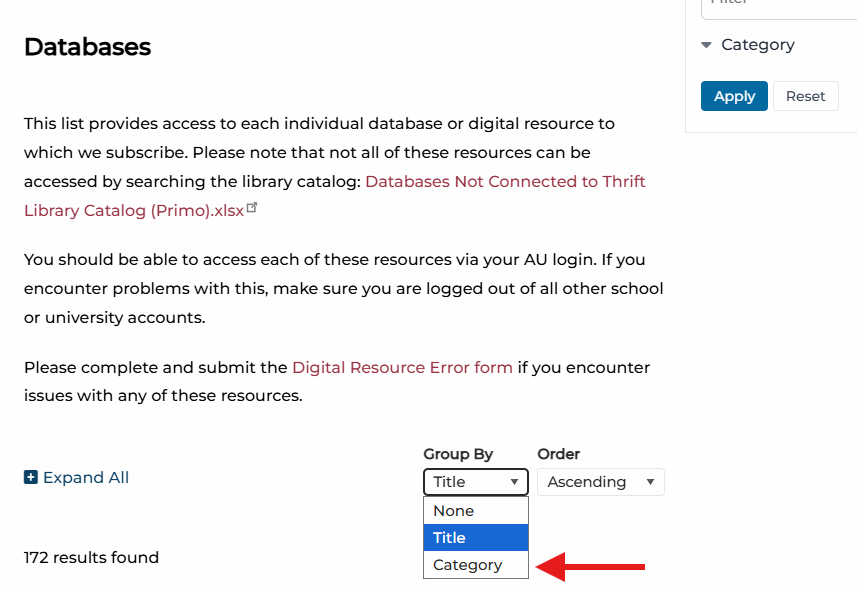
The databases tab of the Thrift Library website includes a feature that filters databases by category, so that users can find all of the databases that are grouped specifically for the course or topic that is relevant to their project. For this course, the relevant groupings would be those of "history," and "interdisciplinary," but if your research topic relates to other subjects, you may be able to find supplementary information in the related subject's grouping.

Chicago-Style Citation Quick Guide

Use the Chicago-Style Citation Quick Guide as an online resource to develop notes and bibliography for your research.

Turabian Quick Guide

The Turabian Quick Guide provides an online resource as a guide for using Chicago/Turabian style.

Zotero

Zotero is a citation guide which you can use to map your research project resources. Through this personal assistant, users can manage any sources they wish to maintain in various folders for organization, and the guide can help produce notes or bibliographies for different writing styles.

Research and Instruction Librarian, Meghan Curtis

Meghan Curtis, Research and Instruction Librarian

Phone: (864) 231-5743 | Email: mcurtis@andersonuniversity.edu

Schedule Appointment

Subjects: Christian Studies, English & Modern Languages, Business, Leadership & Organizations, Honors,  overseeing Art, Theater & Dance, Music, Interior Design, History, Government & Law

Archival Research Associate, Helen Smith

Helen Smith, Archival Research Associate

Phone: (864) 231-2863 | Email: hsmith@andersonuniversity.edu

Schedule Appointment

Subjects: Archives & Special Collections, Art, Theater & Dance, Music, Interior Design, History, Government & Law

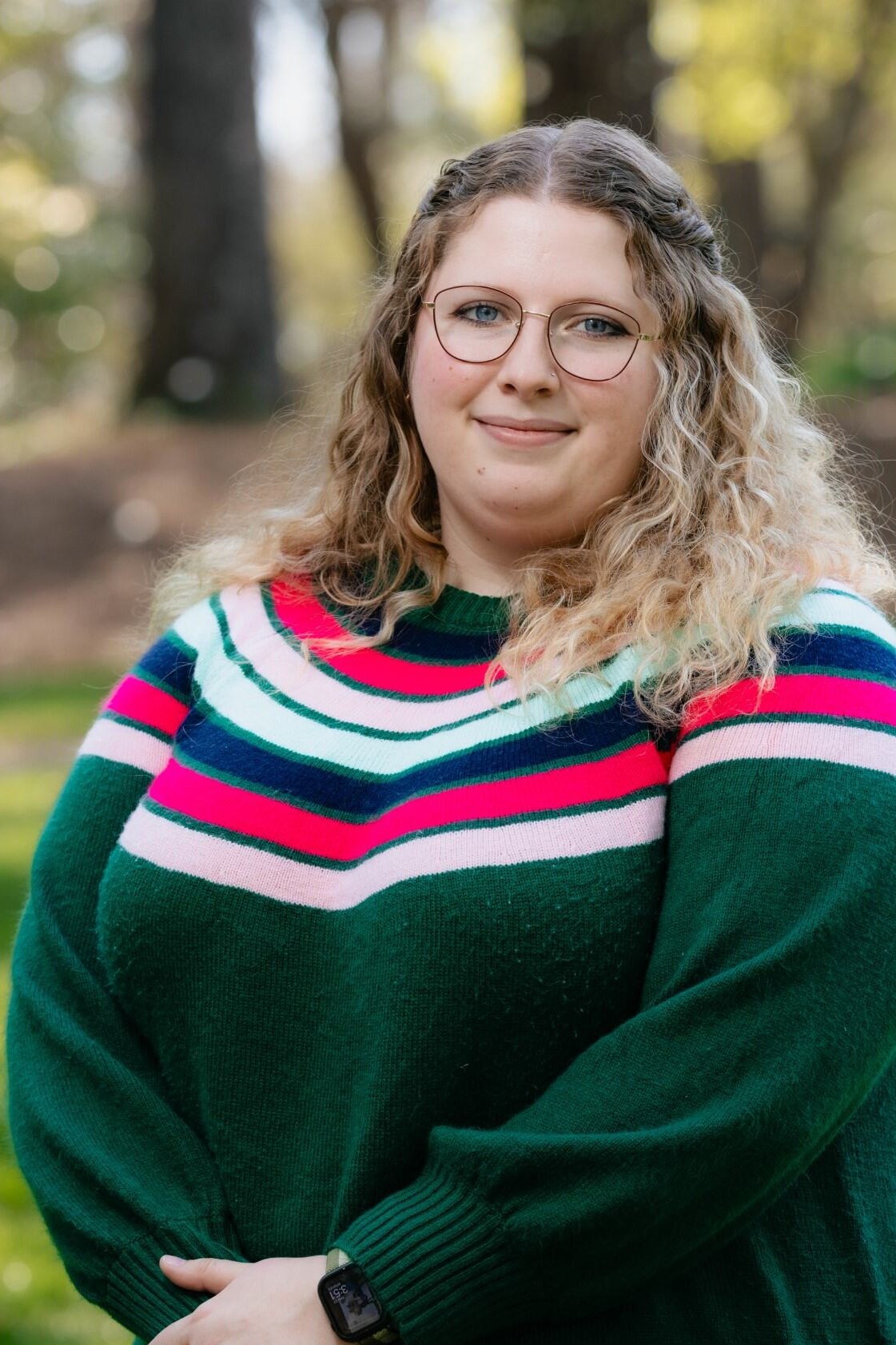
Helen Smith Headshot Ratio