
This research guide covers the history of western music from early times to present. It identifies the best resources and search tools and also provides helpful advice on library research.
Music History
Welcome
Practice Research Skills!
The Reference & Instruction team at Thrift Library have designed a series of Scavenger Hunts to help you practice your skills finding information and using your research skills. These Scavenger Hunts will provide you with five terms to search in Google in order to determine a mystery music artist! Then, you will have the opportunities to further research that person in order to practice more with the library's resources.
Choose any of the following links to participate!
Databases from the Library
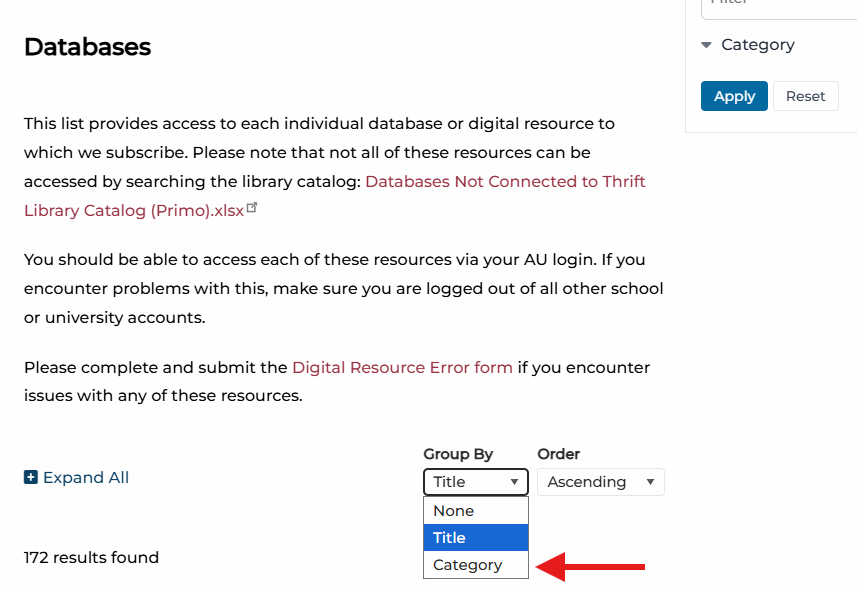
The databases tab of the Thrift Library website includes a feature that filters databases by category, so that users can find all of the databases that are grouped specifically for the course or topic that is relevant to their project. For this course, the relevant groupings would be those of "music," "history," and "interdisciplinary."
Gale OneFile: Fine Arts & Music
Fine Arts & Music
Search millions of articles about drama, music, art history, and filmmaking. Diverse resource for serious fine art students.
Garland Encyclopedia of World Music
Garland Encyclopedia of World Music
With 9,000 pages-- the complete online version of the print set also includes associated audio tracks, musical illustrations, photographs, drawings, song texts, score examples, charts, and maps.
International Phonetic Alphabet
IPA Source
The web's largest library of International Phonetic Alphabet (IPA) transcriptions and literal translations of opera arias and art song texts. Now with over 12,000 titles!
Library Music Source
Library Music Source
This resource contains over 300,000 pages of Western Classical sheet music from over 35,000 works for orchestra, chamber ensemble, piano, organ, voice, chorus, strings, winds, percussion, and guitar.
Oxford Music Online
Oxford Music Online
The Oxford Music Online gateway provides access to multiple music resources including the New Grove Dictionary of Music and Musicians, Oxford Dictionary of Music and The Oxford Companion to Music.
AllMusic
AllMusic lets users sample or purchase music recordings, giving access to the first 30 seconds of hundreds of thousands of recordings, as well as accompanying notes, biographies, reviews, and classical composition descriptions. Users must register to listen, but it is free.

American Ballet Theater
American Ballet Theatre Ballet Dictionary hosts a unique interactive resource designed to bring dance to the Web and make it accessible to everyone.

American Choral Music
The Library of Congress in collaboration with the American Choral Directors Association produced an online encyclopedia in order to access significant choral music in the public domain by the leading American composers from 1870-1923. Users can find digitized items from the collections, special presentations on topics and collections, and articles and biographical essays, finding aids to collections, databases for performing arts resources, and a special Performing Arts Resources Guide which contains entries for hundreds of Library collections, websites, databases, and exhibits.
American Musicological Society
American Musicological Society includes resources such as music history documents, dissertations, websites of interest to musicologists, job listings, conference plans, and much more.

Archives of African American Music and Culture
The Archives of African American Music and Culture (AAAMC) is a repository of materials covering a range of African American musical idioms and cultural expressions from the post-World War II era. The AAAMC collections highlight popular, religious, and classical music, with genres ranging from blues and gospel to R&B and contemporary hip-hop.
Aria Database
The Aria Database is a diverse collection of information on over 1,000 operatic arias. Designed for singers and non-singers alike, the Database includes translations and aria texts of most arias as well as a collection of MIDI files of operatic arias and ensembles.

Baroque Music Pages
Baroque Music Pages contains articles, composer biographies, portraits, and music samples.
ChoralNet
ChoralNet contains forums, choral organizations, choirs, resources, and the latest news of interest to the choral world.
Crank Up the Phonograph
Crank Up the Phonograph: Who We Are and Where We Came from in Early Sound Recordings is a free academic work that attempts to understand how Americans in the late nineteenth and early twentieth centuries viewed themselves, others, and the general world they encountered.

George F. Devine Music Library
The George F. Devine Music Library at the University of Tennessee Knoxville has compiled a wonderful links page to online music collections and library holdings.

Gregorian Chants
Princeton University compiled a list of links and resources from their music department of Gregorian chants.
Internet Broadway Database
The Internet Broadway Database (IBDB) is an online archive of Broadway records of productions from the beginnings of New York theatre until today. IBDB provides a comprehensive database of shows produced on Broadway, including all "title page" information about each production. IBDB also offers historical information about theatres and various statistics and fun facts related to Broadway.

Journal of Music History Pedagogy
The Journal of Music History Pedagogy is a biannual, peer-reviewed, open-access, online journal dedicated to the publication of original articles and reviews related to teaching music history of all levels (undergraduate, graduate, and general) and disciplines. The JMHP holds no single viewpoint on what constitutes good teaching and endorses all types of scholarship on music history pedagogy that are well-researched, objective, and challenging.

National Jukebox
The Library of Congress in collaboration with Sony gives free online access to over 10,000 music and spoken-word recordings produces in the U.S. between 1901 and 1925 through the National Jukebox.

OnMusic Dictionary
OnMusic Dictionary includes browsing by instrument, composers, symbol charts, and various other categories.

Public Domain Information Project
Public Domain Music is a reference site to help identify music and songs in the public domain; this is royalty-free music that users can use anywhere in any way they choose.
Renaissance Channel
Renaissance Channel is devoted to the performance of medieval and renaissance music.

Sheet Music Consortium
The University of California Los Angeles has developed a Sheet Music Consortium that collects an assortment of tools and services to students to access online sheet music by scholars, students, and the general public.

Society for Music Theory
The organizational site for the Society for Music Theory contains a variety of resources for those interested in the fundamentals of music theory, including links to bibliographies and information about computer-aided instruction (can be found under basic theory).
Themefinder
Computer databases Themefinder compiles musical themes where users can narrow down searches by things such as interval, scale, pitch, and contour.
Baker's Biographical Dictionary of Musicians
Slonimsky, Nicolas. Baker's Biographical Dictionary of Musicians. New York: Schirmer Books, 2001.
Available online and in a physical copy at Thrift!
LOC Call Number: ML105 .B16 2001

Basic Music Library

Biographical Dictionary of Afro-American and African Musicians
LOC Call Number: ML105.S67 1982

Biographical Dictionary of Old English Music
Pulver, Jeffrey. A Biographical Dictionary of Old English Music. New York: B. Franklin, 1969.
LOC Call Number: ML106.G7 P9 1969

Biographical Encyclopedia of Jazz
LOC Call Number: ML102.J3 F39 1999

Composers of Yesterday
Briscoe, James. Historical Anthology of Music by Women. Indiana: Indiana University Press, 1986.
LOC Call Number: M1.H57 1987
Encyclopedia of Popular Music

Garland Encyclopedia of World Music

A Guide to Library Research in Music
Bayne, Pauline Shaw. A Guide to Library Research in Music. Lanham, Md: Scarecrow Press, 2008.
LOC Call Number: ML3797.B29 2008

Harvard Dictionary of Music
LOC Call Number: ML100.A64 1969

Historical Anthology of Music by Women

Music Analyses
LOC Call Number: ML128.A7 D5 1991

Music Library and Research Skills
LOC Call Number: ML3797.G68 2009

Music Reference and Research Materials

The New Grove Book of Opera Singers
New Penguin Dictionary of Music

Oxford History of Western Music
Taruskin, Richard. The Oxford History of Western Music. New York: Oxford University Press, 2010.
Taruskin, Richard. The Oxford History of Western Music. New York: Oxford University Press, 2005.
Both editions are available as physical copies at Thrift!
LOC Call Number: ML160 .T37 [Year of preferred edition]

Oxford Music Dictionary
Available online and in a physical copy at Thrift!
LOC Call Number: ML101.U6 N48 2013
For guidance about using Oxford Music Online, click here.

Rock Who's Who

Women in Music

Worship Music
LOC Call Number: ML102.C5 W67 2000

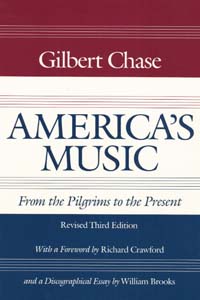
America's Music
Ethnomusicology

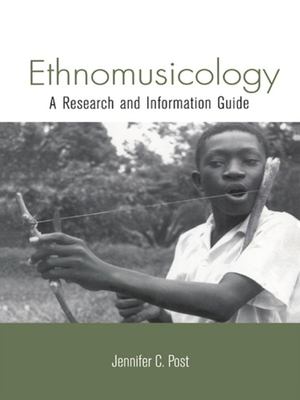
Ethnomusicology: A Guide to Research
Ethnomusicology: History, Definitions, and Scope
LOC Call Number: ML3799.E8 1992

The Garland Handbook of Latin American Culture

The Garland Handbook of Southeast Asian Music

Garland Library of Readings in Ethnomusicology

The Great Composers and Their Works
Slonimsky, Nicolas. The Great Composers and Their Works. New York: Schirmer Books, 2000.
LOC Call Number: ML160.S48 2000

History of Western Music
Miller, Hugh M., and Dale Cockrell. History of Western Music. New York: HarperPerennial, 1991.
LOC Call Number: ML160.C67 1991

Music in the New World
Hamm, Charles. Music in the New World. 1st ed. New York: Norton, 1983.
LOC Call Number: ML200.H17 1983

Music in Western Civilization
Wright, Craig M. Music in Western Civilization. Belmont, CA: Thomson Schirmer, 2006.
LOC Call Number: ML160.W955 2006

Music in the Western World
LOC Call Number: ML160.M865 1984

Musician and Composers of the 20th Century

Oxford History of Western Music
Taruskin, Richard. The Oxford History of Western Music. New York: Oxford University Press, 2010.
Taruskin, Richard. The Oxford History of Western Music. New York: Oxford University Press, 2005.
Both editions are available as physical copies at Thrift!
LOC Call Number: ML160 .T37 [Year of preferred edition]
Thinking Musically
LOC Call Number: ML3798.W33 2004

Analysis
Apel, Willi. The History of Keyboard Music to 1700. Bloomington: Indiana University Press, 1972.
LOC Call Number: ML549.A6413
![The History of Keyboard Music to 1700 [Book]](https://pictures.abebooks.com/isbn/9780253211415-us.jpg)
Schoenberg, Arnold. Theory of Harmony. Berkeley: University of California Press, 1978.
LOC Call Number: MT50.S37 1978


Instruments
LOC Call Number: ML552.I75 1965

Gänzl, Kurt. The Encyclopedia of the Musical Theatre. American ed. New York: Schirmer Books, 1994.
LOC Call Number: ML102.M88 G3 1994

Theater
LOC Call Number: ML128.M78 B6 1996

LOC Call Number: ML1950.J22 1977

Gottfried, Martin. Broadway Musicals. New York: H. N. Abrams, 1979.
LOC Call Number: ML1711.8.N3 G68 1979
Norton, Richard C. A Chronology of American Musical Theater. Oxford ; Oxford University Press, 2002.
LOC Call Number: ML1711.8.N3 N67 2002

LOC Call Number: MT95.G19 1995

Gänzl, Kurt. Ganzl’s Book of the Musical Theatre. 1st American ed. New York: Schirmer Books, 1989.
LOC Call Number: MT95.G2 1989


Lewine, Richard. Songs of the Theater. New York: H.W. Wilson Co., 1984.
LOC Call Number: ML128.S3 L55 1984

LOC Call Number: ML102.M88 H6 1993

Opera
LOC Call Number: ML128.V7 B3 1950


LOC Call Number: ML48.B66 1996


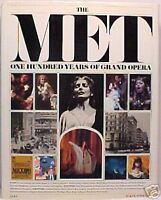
Mayer, Martin. The Met: One Hundred Years of Grand Opera. New York: Simon and Schuster, 1983.
LOC Call Number: ML1711.8.N3 M46 1983
Songs
LOC Call Number: ML128.M78 B6 1996
LOC Call Number: ML128.R6 F56 1984

LOC Call Number: ML128.S3 L4 1989

LOC Call Number: ML128.H8 T46 1998

Source Readings

LOC Call Number: ML160.M865 1984
LOC Call Number: ML160.S89 1950

Scores
Scores may be cataloged in multiple formats, such as books, reference books, and miniature scores. There are also many websites containing free scores and sheet music.
Musical Scores are cataloged in the M's according to the Library of Congress Classification System.
M – Scores
ML – Literature on music
MT – Musical Instruction and Study
To find a score in OneSearch, search for the composer or composition, and then limit your search to Score.
Be mindful of spelling errors or variations of spellings.

Accessing a Physical Book
Thrift Library is home to over 70,000 books. They can be very helpful when researching and working on projects. But how do you access them? Here is simple guide showing the two main ways of finding a physical book.
Step 1: Search for the book
Begin by looking in the Thrift Library catalog. You can then narrow your search from the results page. This video gives you a quick tutorial:
Simple Search:
You can do a simple search by entering the book title and/or the author into the search box. If you want to find books on your topic, enter 1-3 keywords that describe your topic. Keyword examples: ancient Greek vases; Vincent van Gogh; sculpting in the 19th century; Chinese wall hangings.
Advanced Search:
For more precise searching use the Advanced Search. Click "Advanced Search" to the right of the search box. Fill out the boxes to limit to specified fields like Title or Author.
Physical Items:
From the search results page you can limit your results to physical books held by Thrift Library. Look to the left side of the page under "Refine my results" and select the following options:
Under Resource Type, select Books
Under Availability, select Held by library
Step 2: Locating the book
Once you have identified the book you wish to use, note the call number (example: LC3731.F45 2002) and navigate to the stacks (shelves) on the second floor of the library. There is signage there to direct you in finding the items according to its call number.
Library of Congress Classification System
A call number is like an address for a book. It tells you exactly where to go to find the book on the shelf. The call number is made up of letters, whole numbers, decimals, a publication date, and occasionally a volume and/or copy number. This allows for each book to have a specific location. One book's location cannot be confused with another book's location.
Thrift Library uses the Library of Congress Classification System; here is an example: LA 212 .R423 2005.
LA specifies the subject classification (L for Education and A for History, so History of Education).
212 is read as a whole number.
The next line, .R423, is called the Cutter number. This line is read as a decimal (.R423 would come after .R76).
2005 is the publication date.
Step 3: Checkout
Once you have acquired your book, you are free to peruse it at your leisure. If you have finished using it while you are here, return it to the desk. If you want to take it with you, you can check it out. All you have to do for that is to come to the front desk with your student ID, which serves as your library card. Someone should be there to assist you. They will then check out the book and let you know about the due date for return, and you can check that by signing into the catalog at any time after checking out!
PASCAL and Interlibrary Loan
If Thrift does not have something you are looking for, you can request it from other libraries!
PASCAL Delivers
PASCAL Delivers is a FREE, rapid delivery interlibrary loan (ILL) service for print books and digitized copies of journal articles and book chapters.
- Use the catalog as you normally would (i.e. the above instructions.) after signing in using your AU credentials.
- If you cannot find the item(s), enable "Add results available through interlibrary loan" under the "Refine my results" menu on the left side of the page:
- Click on the title of the item you would like to request and click the appropriate button to open the PASCAL Delivers Request Form. Make sure that the bibliographic data you provide in the form is complete and accurate.
- Physical books will arrive at the PASCAL library location you selected within 2-14 days. You will receive an email when your items are ready for pickup. Digital items will be emailed directly to your AU email account, typically within 1-5 days.
ILL Request Options
All loaning systems in addition to PASCAL can be found here.
For any questions about these services, you can contact [email protected].
Reading LOC Call Numbers
- Visit the second floor of Thrift Library, where you'll find the stacks!
- Look at the first letter(s). Books are arranged in alphabetical order.
- N comes before P
- PL comes before PN
- Browse the signs on the end of the bookshelves to find your section
- When you find the correct shelving area, scan over the numbers on the spine label (102 is one hundred two, not 1-0-2).
- After that number, search alphabetically from the other letter after the decimal.
- Some copies are arranged by publication date as well, the year will appear at the end of the call number.
Example
NB 1115 .A32 2020
NB is the section to search for, in alphabetical order between NA and NC.
1115 is the numbers before the decimal in numerical order on the shelf.
A32 after the decimal will be in alphabetical and then numerical order.
2020 is the publication year. If another edition of the same book was published in 2018, the two copies will be right next to each other with 2018 appearing first because they are shelved in chronological order.
Databases from the Library
The databases tab of the Thrift Library website includes a feature that filters databases by category, so that users can find all of the databases that are grouped specifically for the course or topic that is relevant to their project. For this course, the relevant groupings would be those of "music," "history," and "interdisciplinary."
Accessing E-Books and articles
Begin by looking in the Thrift Library catalog. You can then narrow your search from the results page.
This video gives you a quick tutorial:
Simple Search
You can do a simple search by entering the book title and/or the author into the search box. If you want to find books on your topic, enter 1-3 keywords that describe your topic.
Keyword examples: ancient Greek vases; Vincent van Gogh; sculpting in the 19th century; Chinese wall hangings.
Advanced Search
For more precise searching use the Advanced Search.
Click "Advanced Search" to the right of the search box.
Fill out the boxes to limit to specified fields like "Title" or "Author."
Limit Search Results to E-Books
From the search results page you can limit your results to electronic (digital) books held by Thrift Library.
Look to the left side of the page under "Refine my results" and select the following options:
- Under "Resource Type," select "Books"
- Under "Availability," select "Available online"
Articles and Journals
From the search results page you can also look at physical items, articles, or essays written on the topic of your choice.
Use "Refine my results" to hone in on these as well by selecting things like Peer-Reviewed Journals and Articles.
Accessing Periodicals and Journals through the Library Catalog
Search for Articles
The Thrift Library catalog provides access to peer-reviewed, scholarly journals and trade journals in digital format via its many databases.
Locate an Article
After logging into the catalog using your AU credentials, use the search box in the Thrift Library catalog to search for articles across most of the library's subscription databases.
Not all databases are integrated with our catalog. Searching individual databases will help you cast a wider net.
On the search results page, look under "Refine my results" on the left side.
Select "Peer-Reviewed Journals" and "Articles."
To exclude other options, select the red box beside a filter, such as the one for "Review Articles" so that your results are limited to the type of article you want.
An example screenshot with these filters on would be this:
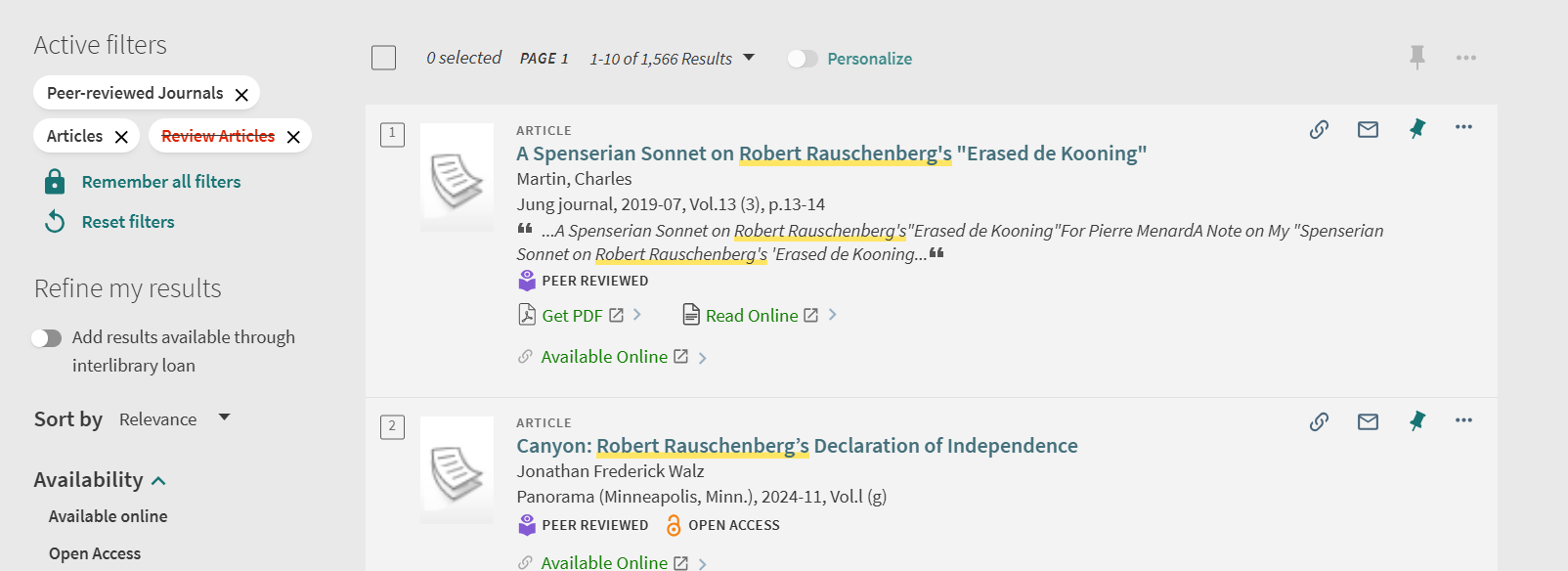
Once you locate an item, open its record and scroll to the "View Online" section to see which database(s) provide access to it.
Note that databases provide two types of search results:
1. Actual sources, which include the full-text article.
2. Surrogate records, which only provide the article's metadata such as the author's name, article and journal titles, publication information, and an abstract and/or summary.
If the catalog record does provide access to the full-text of the article, follow the PASCAL Delivers instructions to request that it be emailed to you through interlibrary loan (ILL).
Select a database to access the article from the available options. If it provides full text, there should be an option to view/download a PDF.