Guide to Graduate Research

Source Types

Graduate researchers will engage with various types of information sources throughout the research process. In scholarly writing, information is categorized into one of three main source types: Primary, Secondary, or Tertiary. 

Sources are categorized by their "distance" from the original event, data, work, etc.  


Primary Source

Secondary Source

Tertiary Source   

Definition

Information in its purest form - before it has been analyzed or commented on. 

Information that analyzes or interprets primary sources but offers no new evidence.

Information that compiles, summarizes, or condenses primary/secondary sources on a particular topic or group of topics.

Characteristics

Raw data, original artifacts, first-hand accounts.

Interpretation, analysis, critique, review.

Summary, broad overview, compilation (typically includes only citations)

Uses

Personal interpretation/analysis, direct evidence, claim confirmation.

Literature review, summary of opinions, support for claims/analysis.

Topic exploration, basic research, fact-finding.

Examples

Interviews/transcripts, speeches, diaries, birth certificates, scientific research (data), newspaper articles, original literature, artifacts, etc.

Biographies, journal articles, textbooks, commentaries, literary criticism, scientific research (findings/analysis), etc.

Encyclopedias, bibliographies, abstracts, indexes, catalogs, dictionaries, literature reviews, etc.

Each type of source has its place in academic research. Typically, researchers first interact with a topic through tertiary sources then explore secondary and primary sources as they dig deeper into their research. The appropriateness of each type of source for academic use varies widely by the nature and topic of the research, with each serving a unique function. 
Periodical Literature

Periodical (serial) Literature is curated literature, which is published at regular intervals (periodically). Newspapers, Magazines, and Journals are the most common types of periodical literature and are often classified into three categories based on their authors, purpose, content, and intended audience: Scholarly, Popular, Trade. 


Scholarly

Popular

Trade

Author(s)

Scholars, subject-matter experts

Journalists 

Business/industry professionals

Purpose

Educate, discuss research, present findings

Entertain, inform

Share industry news, discuss industry trends, review products  

Audience

Scholars, researchers, students

General public

Business/industry professionals

Content

Research papers, literature reviews, peer-reviewed articles, minimal/no ads, extensive citations/bibliographies.

News, editorials, photojournalism, numerous ads, minimal citations.

Product reviews, interviews/biographical articles, news articles, industry-specific ads, limited/informal citations.

Examples

New England Journal of Medicine, Shakespeare Quarterly, English Historical Review

Time Magazine, USA Today, National Geographic

Popular Mechanics, Ad Age, Christianity Today

Understanding what type of periodical literature, you’re looking at is the first step toward selecting appropriate sources for your research. While students tend to cite scholarly articles in academic research, some may find trade, or even popular, sources effective for their work, depending on the nature of the research.

Peer Review

What Is Peer Review?

Peer-reviewed articles are often considered the “gold standard” in academic research and writing, especially in scientific fields, because they’ve undergone an extensive process of review by a variety of qualified professionals within the author’s field of study who consider the credibility and value of the research conducted before it is published. 

Peer review as we know today was established in the mid-1970s, but the concept of like-minded experts reviewing research began with the Royal Society of London in the 17th century. Prior to this time, publishers heavily favored well-known and well-versed authors, regardless of the quality of their content. 

The Process: 

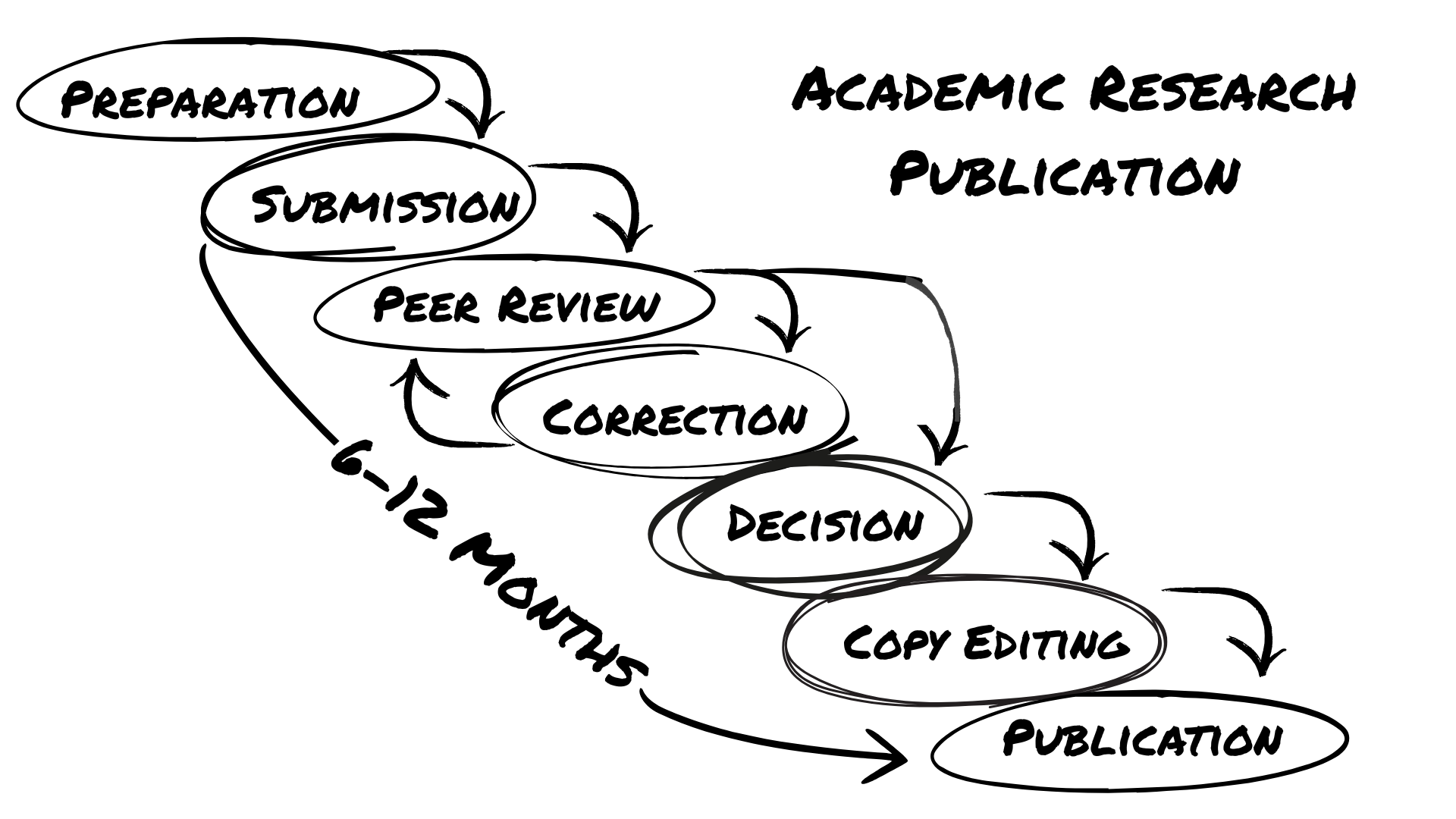
The process of publishing through a peer-reviewed journal is lengthy. Not counting the time spent on research and writing, anywhere from 6-12 months can pass from submission to final publication. 


When a researcher submits works for publication, the journal’s editor first reviews the manuscript to ensure that the scope and theme are a fit for the journal. If selected, the manuscript is then sent to 2-4 experts in the researcher’s field of study (peers) for a thorough evaluation of the manuscript’s methodology, originality, and significance. Peer reviewers provide feedback to the editor along with a suggestion to either accept, reject or revise the work.

 If revision is required, the researcher will make any necessary changes before resubmitting the work for further review. Once the reviewers are finished, the journal editor makes the final decision to either reject or accept the manuscript. At this time, the article is sent for final editing and formatting before finally being published.

Caution

Searches limited to only peer-reviewed content often result in valuable material being overlooked. Information regarding current events or historical information published prior to the formalization of peer-review may be excluded when this filter is applied. Consider what types of information is needed for your project before applying the peer-review filter to your search. 

Identifying Scholarly Content

As a graduate student, you’re responsible for evaluating the sources you reference in your writing. Scholarship demands that your resources be appropriate for your research - and you’ll need to consider each source you cite to determine whether or not it meets your research needs. 

The TRAAP method is a systematic approach to assessing source quality which helps you move beyond surface-level judgements and did deeper into the appropriateness of a source in the context of your unique research needs: 

TRAAP stands for: 

Timeliness – Relevance – Authority – Accuracy – Purpose 


Timeliness

  • When was the information published or updated?

  • Is the information current enough for your topic or discipline? 

  • If the information is older, is it a foundational or seminal work in the field?

  • Does my research demand historical context that can be fulfilled by this resource?


Note: Currency requirements vary by discipline. Scientific and medical research typically requires recent sources (within 5-10 years) while historical analysis, literary criticism, or theological studies may rely more on foundational works from decades or centuries past. Perhaps your research calls for a combination of both.


Relevance

  • Does this source directly relate to my research question?

  • Does it provide supporting context?

  • Is it at an appropriate level (too basic, too advanced, just right)?

  • Who is the intended audience?


Consider: A source can be highly credible, but still inappropriate for your research. Each source must be relevant to your specific argument or research focus so that readers can clearly see why you’ve chosen to include it.


Authority

  • Who is the author/publisher?

  • What are their credentials and expertise? 

  • What type of authority is relevant for this topic? (Academic credentials, professional experience, lived experience, specialized training?)

  • Does their background match the kind of knowledge my research requires? 


Remember: Authority looks different across contexts. Academic credentials matter for scholarly research, but professional experience, lived experience, or specialized training may be equally or more valuable depending on your topic.

Accuracy

  • Is the information supported by evidence?

  • Can I verify the information with other sources?

  • Are there citations, and do they lead to credible sources?


Tip: Cross-reference claims with multiple reputable sources. Even peer-reviewed articles can contain errors or be later retracted.


Purpose 

  • Why does this information exist? 

  • Does the author have a bias or agenda? 

  • Does the purpose affect the content and presentation?


Important: All authors (yourself included) are biased. The goal isn’t to find completely neutral sources, but to recognize bias and account for it in your analysis.


The following AI Chatbots are programmed to help you evaluate sources according to the TRAAP method:

TRAAP Teacher - https://box.boodle.ai/a/@TRAAPTeacher

This AI tool walks you through using the TRAAP method for evaluating an article for use in an academic paper. Using a provided source and research context, you'll be prompted to complete each step of the analysis. The bot will complete its own assessment and compare its findings to yours.

Source Evaluation Assistant - https://box.boodle.ai/a/@SourceEvaluationAssistant

This AI tool helps you evaluate sources for scholarly value by analyzing your source according to the TRAAP method and comparing it to standards for your field of study, level of study, and provided project details. You'll still make the final decision regarding the appropriateness of the source for your unique research needs - but this tool saves you time by providing a comprehensive analysis of the source in the context of your research.


Determining Search Terms

Most search platforms function in one of two ways: keyword searching or natural language searching. Natural language searching allows you to enter your full research question or thought in your own words; the system then translates that question into searchable keywords and conducts its search. Keyword searching requires that you remove unnecessary words and provide the keywords yourself. 

Keyword searching is more prevalent in library catalogs and databases, though natural language searches are starting to make their way into these platforms through AI tools (such as the Primo Research Assistant). 

Until natural language searching is widespread, it remains essential to know how to determine functional keywords for your searches. 

How to turn a research question into functional keywords:


Step 1: Start with Research Question or Thesis 

What are the negative effectives of social media addiction on the mental health of today’s college students?


Step 2: Remove Unnecessary words

  • Articles – a, an, the

  • Pronouns – it, they ,their

  • Prepositions – of, in, on, that

  • Question words: What, are, how,

  • Adjectives and verbs (unless they’re central to your topic)

negative effects, excessive social media addiction, mental health, college students


Step 3: Reconsider Biased and Limiting Language

  • Avoid Value Judgements – harmful, beneficial, dangerous, positive, etc.

  • Remove assumptions – addiction, obsession, excessive, etc.

social media, mental health, college students


Step 4: Identify Related Terms 

  • Consider Broader Vocabulary

  • Consider Narrower Vocabulary

social media, Instagram, TikTok, social networking, online platforms, social networks, mental health, psychological health, emotional health, mental wellness, college students, undergraduates, university students, young adults, emerging adults, post-secondary students


Basic Search Techniques

Most library catalogs and databases default to a “basic search.”  Basic searching typically yields a large number of results and is useful for early-stage research and for familiarizing yourself with the types of information available for your topic. 

Keyword Searching

  • Enter 2-5 keywords into the library catalog’s “Basic Search” bar. 
  • Results include sources that include one or all of the keywords ANYWHERE in the item record: Title, Full text, Abstract, Review, Publisher, Author, Subject, etc.

Search Filters

  • Narrow or broaden your search by selecting filters from the “Tweak your results” field on the catalog menu: peer-review, date of publication, subject, type, etc.
  • Most databases have a similar menu for filtering results.

Advanced Search Techniques

Subject Searching 

Searching by subject is useful for later-stage research that calls for more specifically applicable resources. 

Information experts from Library of Congress and other well-known institutions conduct in-depth analysis of published materials to assign “subject” classifications which are used by libraries around the globe.  Subject terminology (controlled vocabulary) can be specific and technical – varying from the terms you determined for your research. 

Results in the library catalog use the following controlled vocabularies: 

The simplest way to identify subjects for searching is to browse the results of a keyword search for applicable resources, then view the record’s “Subjects” list. Each subject listed is a clickable hyperlink leading to a search for all records with that subject classification.

Tip: Search for items matching more than one subject using Boolean Operators (see below) in an advanced search to pinpoint the results you need.

Boolean Operators

George Boole (1815–1864) was a pioneering English mathematician, logician, and philosopher who laid the foundation for modern symbolic logic and Boolean algebra. His work is fundamental to the logic used in search engines today – Boolean Logic.

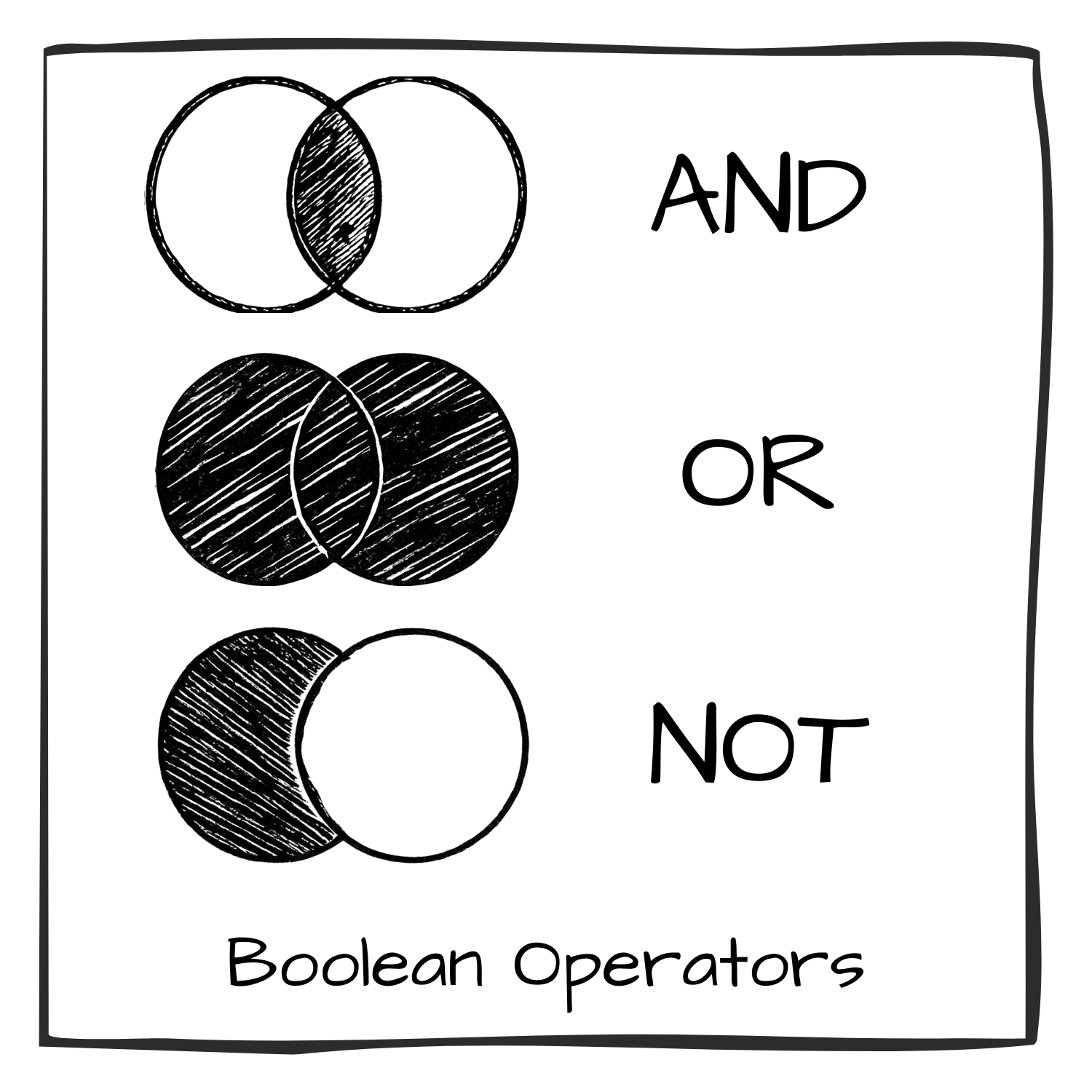
The three main Boolean Operators used in information searching are AND, OR, and NOT.  These terms are used by search engines to connect keywords and construct logical search queries that enable search engines to refine results.

The AND operator is used to narrow results by searching for only records that contain both terms.  i.e. Mathematics AND Education

The OR operator is used to broaden results by searching for records that contain at least one of the terms. i.e. Mathematics OR Education

The NOT operator is used to narrow results by searching for records that contain one result but include no mention of the other. i.e. Mathematics NOT Education.


Advanced catalog searching allows the combination of numerous terms using Boolean operators to produce extremely specific search queries. While applying Boolean operators can be very useful in narrowing your search results, it can also be extremely limiting and remove too many results for functional research. Try various combinations of terms until you find the balance of narrow and relevant results.

Note: Operators will be applied in linear order, so “Mathematics AND Education NOT University” will yield different results from “Mathematics NOT University AND Education”. 

Other Techniques


Quotation Marks

Placing quotation marks (“”) around multiple terms ensures that the system only searches for records in which those terms appear as a phrase, exactly as they appear within the quotation marks. 


i.e.  “social media algorithms”


Tip: Be sure to check your spelling when using quotation marks.


Truncation

Truncation uses an asterisk (*) following a root word or shortened word to search for records that include various derivatives of the word.


 i.e. psycholog* (psychology, psychologist, psychological, etc.) 


Wildcard

Wildcard searching utilizes an asterisk (*) within a word to indicate any number of characters or a question mark (?) to indicate a single character within a word.  This is useful for locating various spellings or forms of a word. 


i.e. behavi*r (behavior, behaviour), wom*n (women, woman)


Research Tools